
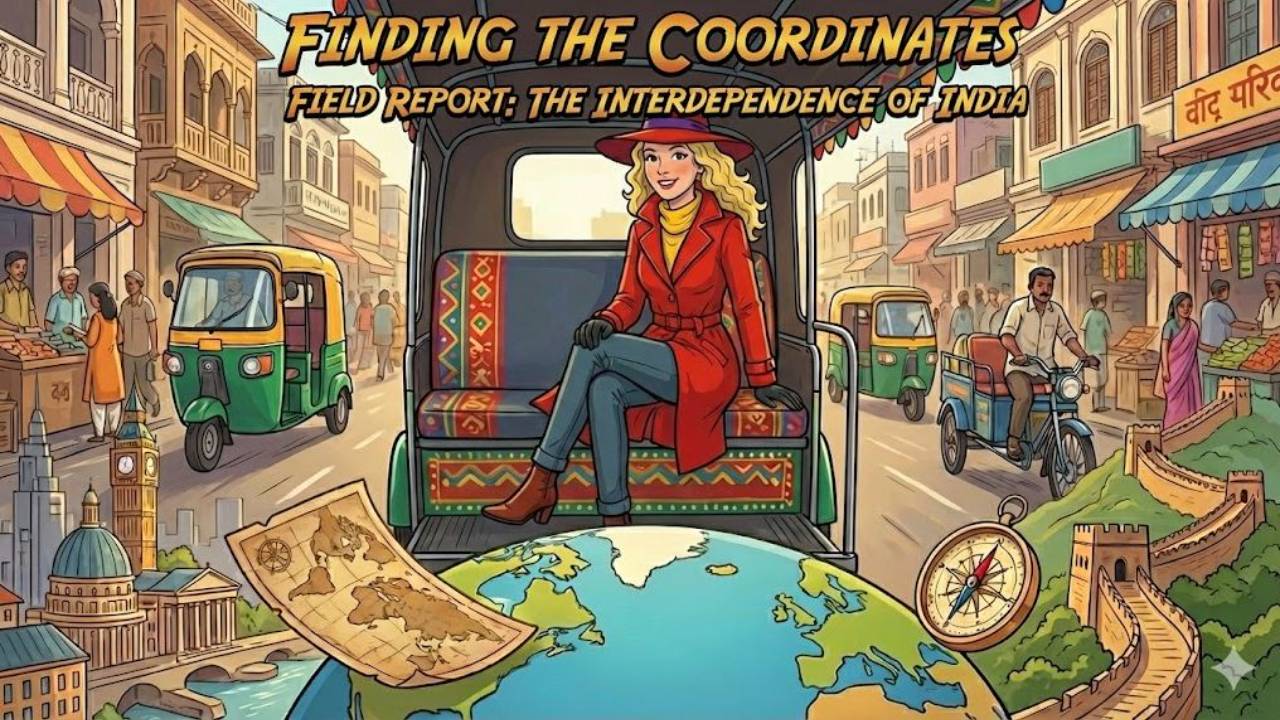
Finding the Coordinates | Field Report: The Interdependence of India
Dec 21, 2025When you play the "International Woman of Mystery," you expect to navigate lost train stations or confusing menus. You don't necessarily expect to navigate the intricate, communal, and sometimes overwhelming systems of foreign medical care.
This past week, the coordinates shifted from "exploration" to "survival." We dealt with two medical crises at once: a significant life-threatening emergency for Adiya's brother-in-law and my own mysterious allergic skin reaction to an Ayurvedic treatment I had tried for my ongoing pelvic pain. Or so we think that's the culprit.
Through the haze of itching pain and antihistamines, I witnessed a side of India that a tourist will never see.
The Family Net: A 24/7 Operation
In the West, we view medical care as a private, individual experience. In India, it is a collective mission. When Adi’s brother-in-law was admitted to the ICU, the "rules" of engagement were a total culture shock to me:
-
The Waiting Room: While ICU visiting hours are strict, the family is expected to be present 24/7. This doesn't happen in a climate-controlled lounge; it happens in an outdoor waiting area, regardless of the weather.
-
The Family as Staff: The hospital provides the doctors, but the family provides the logistics. Aditya was a prime care taker and was tasked with running to the pharmacy to buy the specific medications needed and the family was responsible for bringing every meal to the patient.
-
The Relocation: This was the most surprising part. Even though everyone lives in the same city, the entire extended family relocated to one house for the duration of the hospitalization. They pooled resources for cooking and childcare, ensuring no one was left to handle the crisis alone.
My Plot Twist: The Rickshaw and the Language Barrier
While the family was rallying for the ICU, I was spiraling into a massive allergic reaction. In my continued search for relief from uterine fibroids, I had tried a local Ayurvedic medicine that we suspect my body rejected violently.
Navigating the medical system as the patient was a "rushed" and humbling experience:
-
No Appointments: There is no "calling ahead." Adi’s dad went to the clinic early in the morning just to wait and secure a time slot for me.
-
The Journey: Once we had a "spot," Adi’s sister took me to the dermatologist via rickshaw.
-
The Dynamic: Despite the doctors speaking English, they consistently chose to speak in Marathi to Adi’s sister rather than to me. I felt like a passenger in my own medical care, not being listened to directly, while decisions were made around me.
What I’ve Learned
I eventually got the three different prescription antihistamines I needed to stop the reaction, but the realization hit me hard: I could not have done this on my own.
In my "Carmen Sandiego" life, I pride myself on independence. But this week taught me that in India, the greatest strength isn't independence—it’s interdependence. Whether it’s Adi acting as my advocate, his dad waiting in a clinic line, or the family relocating to support one another, the "coordinates" of this life are held together by the people around you.
Click below to learn more about Blue Side Adventures and how you can reclaim your freedom and start your own journey Back Home.
Let's connect and keep you updated!
Got a question? Want to say hi? Hit the button below. You can send me a message and join our mailing list to receive the latest news and updates from our team.
Don't worry, your information will not be shared.
We hate SPAM. We will never sell your information, for any reason.
